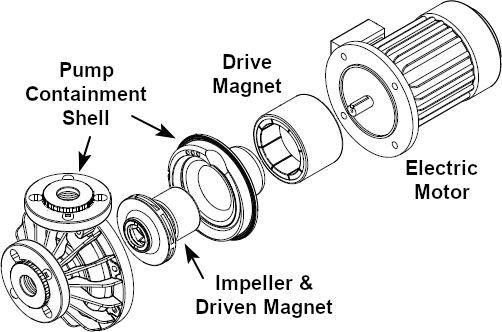
A Magnetic Drive Pump is typically a centrifugal pump in which the rotational energy of the impeller is provided by a driver, such as an electric motor. Instead of transmitting energy directly through a shaft, the energy is transmitted indirectly through a magnetic coupling. This design allows the wet end of the pump to be hermetically sealed.
Because of this seal-less construction, the mag drive pump is widely used in applications where leakage control is important. For buyers, plant owners, and engineers, understanding the construction of an industrial magnetic pump helps clarify where it performs well, where caution is needed, and how it compares with a mechanical seal pump.
Working Principle of the Magnetic Drive Pump
Using an electric motor as an example, a drive magnet is attached to the motor shaft, either directly or indirectly. On the pump side, a driven magnet is attached to the pump impeller. The drive magnet and driven magnet form the magnetic coupling, with the rear containment shell positioned between them.
As the motor rotor turns, the drive magnet rotates. The driven magnet rotates in sync with the drive magnet, which in turn rotates the impeller. This generates the centrifugal force needed for the pump to produce the flow and pressure required to move the liquid.
This is the basic operating principle of a Magnetic Drive Pump. Since power is transferred magnetically rather than through a shaft seal, the pump can maintain a leak-free wet end under normal operating conditions.
Pros and Cons of the Magnetic Drive Pump
When evaluating the advantages and limitations of a Magnetic Drive Pump, the comparison is usually made against the mechanical seal pump. In the centrifugal pump market, mechanical seal pumps continue to hold a large share of industrial applications, so they remain the most practical point of comparison.
For many chemical-duty applications, the mag drive pump is chosen because of its leak-free design. However, like any pump technology, it also has operating limits that should be understood before selection.
Advantages of the Magnetic Drive Pump
Leak-free design
The absence of a mechanical seal gives the Magnetic Drive Pump many of its key advantages. The wet end of the pump is hermetically sealed, which means there is no external leakage of the pumped chemical under normal operating conditions. Because of this, magnetic drive pumps are one of the most effective solutions for meeting strict environmental and safety requirements, especially when handling hazardous chemicals.
Easier maintenance and lower downtime
Repair and maintenance are also generally easier and less costly, since there is no mechanical seal to replace, align, or flush. In many applications, the industrial magnetic pump requires very little routine maintenance, making it suitable for continuous-duty service with minimal downtime.
The number of wear components is also relatively low. In many cases, the mean time between failure (MTBF) of these components is longer than that of a typical mechanical seal.
Lower total cost of ownership
The initial purchase price of a Magnetic Drive Pump may be slightly higher than that of a mechanical seal pump. However, because a mechanical seal pump often requires multiple seal replacements during its service life, the overall total cost of ownership of a mag drive pump can often be lower over time.
Compact construction
Mechanical seal pump construction can become quite complex when chemical leakage must be prevented. In such cases, the system may require double mechanical seals, external flushing systems, pressure monitoring, and other support arrangements.
A Magnetic Drive Pump, by contrast, is leak-free by design. Its construction can therefore remain compact, typically consisting of the pump, the magnetic coupling, and the motor. As a result, magnetic drive pumps are often smaller and easier to integrate into existing systems, especially when built to ISO or ANSI design standards.
Limitations of the Magnetic Drive Pump
A Magnetic Drive Pump is highly effective for many hazardous chemical applications that require a leak-free design. However, several limitations should be considered when deciding whether it is the right solution.
Dry running must be avoided
The wear components of the Magnetic Drive Pump are located inside the pump, typically between the pump shaft and the slide bearing. As the impeller rotates, friction between the shaft and bearing creates heat and requires lubrication and cooling.
Because the pump uses the pumped liquid as both lubricant and coolant, the following conditions must be met:
- The pump must be filled with liquid before startup and properly primed.
- The Magnetic Drive Pump should never be allowed to run dry.
- The manufacturer’s minimum flow requirement must be observed to provide adequate cooling for the shaft and slide bearing.
Material and temperature limits must be observed
A mag drive pump can be constructed from a range of materials chosen for compatibility with specific chemicals. Each material also has its own recommended operating temperature range. If the pump is used above the recommended temperature limit, overheating and pump failure may occur.
Solids can damage internal components
Inside the industrial magnetic pump, the clearances between moving and stationary parts are very small. Examples include the clearance between the shaft and bearing, and the clearance between the driven magnet and the rear containment shell.
If solids are present in the pumped liquid, several risks must be considered:
- Excessive solid particles or sludge can collect between the driven magnet and the rear containment shell, causing wear to both parts. If the rear containment shell is worn through, chemical leakage may occur.
- Some particles may be small enough to enter the space between the driven magnet and the rear containment shell, but large enough to become lodged there. As the driven magnet rotates, these particles can scrape both surfaces and eventually lead to leakage.
- Fine particles that pass between the shaft and the slide bearing may also cause wear if the particles are harder than the shaft or bearing material, which can shorten component life.
Decoupling can occur under excessive load
Unlike a mechanical seal pump, where the motor shaft is physically connected to the impeller, the power transmission of a Magnetic Drive Pump depends on the magnetic field between the drive and driven magnets. Because of this indirect connection, the coupling can disengage under certain conditions. This is known as decoupling.
Common causes of decoupling include the following:
Specific gravity and viscosity
Specific gravity describes how heavy the liquid is compared with water, while viscosity describes how thick or resistant to flow it is. Both higher specific gravity and higher viscosity increase the pump load. If the load exceeds the torque rating of the magnetic coupling, decoupling can occur.
Crystallization
Some chemicals may crystallize at lower temperatures or while the pump is stopped. As crystals form, they may cause the bearing and shaft to seize, preventing the driven magnet from rotating. When the pump restarts, the starting torque may cause the coupling to decouple.
Coating
Unlike crystallization, which is primarily caused by temperature change, coating is a chemical reaction that results in solid deposits forming on internal pump surfaces. This buildup reduces the clearance between the shaft and bearing and increases friction. The result may be overheating, component damage, or seizure of internal parts, any of which may lead to decoupling.
Typical Applications of the Magnetic Drive Pump
The key applications of the Magnetic Drive Pump are closely related to its leak-free design. It is commonly used for chemicals with the following characteristics:
- Highly corrosive chemicals, such as strong acids and alkalis, where direct contact with personnel should be minimized. These chemicals are commonly used in waste chemical neutralization and in many chemical processing plants.
- Flammable fluids that need to be sealed to prevent accidental exposure to ignition sources. Solvents are common in many general industries, while light hydrocarbons are often found in petrochemical plants.
- Toxic chemicals that can seriously harm the environment and wildlife.
- High-purity chemicals that must not be exposed to contaminants, such as those used in electronics, semiconductor, pharmaceutical, medical, biotechnology, and food-related industries.
- Chemicals that degrade when exposed to air or water.
For these reasons, the industrial magnetic pump remains a preferred option in many applications where leak prevention, chemical compatibility, and operational safety are critical.
FAQ
What is a Magnetic Drive Pump?
A Magnetic Drive Pump is a centrifugal pump that uses magnetic coupling to transfer power from the motor to the impeller without a direct shaft seal, allowing the wet end to remain hermetically sealed.
What is the main advantage of a mag drive pump?
The main advantage of a mag drive pump is its leak-free design, which makes it especially suitable for hazardous, corrosive, toxic, flammable, or high-purity chemicals.
What is the main limitation of an industrial magnetic pump?
One important limitation is that an industrial magnetic pump should not run dry, because the pumped liquid is used to lubricate and cool internal components.
Can solids damage a Magnetic Drive Pump?
Yes. Solids, sludge, or abrasive particles can damage internal clearances, bearings, and the containment area, which may shorten service life or lead to leakage.
What causes decoupling in a Magnetic Drive Pump?
Decoupling can happen when the operating load exceeds the torque capacity of the magnetic coupling. Common causes include high viscosity, high specific gravity, crystallization, and coating.
Final Thoughts
Understanding Magnetic Drive Pump construction is important when evaluating pump technology for chemical service. Its seal-less design offers clear advantages in leakage prevention, safety, compactness, and long-term maintenance. At the same time, proper application review is essential, especially where dry running, solids, temperature limits, or decoupling risk may be involved.
For operations that require reliable leak-free pumping, it is worth reviewing available centrifugal magnetic drive pump solutions and comparing them against the process conditions of the application. To learn more about the company, visit ASSOMA Our Company. To explore related products, visit ASSOMA Shop. If you would like to discuss your application in more detail, you can also contact ASSOMA.